It Started with a Magazine
In July 1953, Popular Science magazine ran an article called “Build Your Own Diving Lung.” It wasn’t aimed at engineers or military contractors. It was written for regular people — the kind of reader who owned a set of hand tools, had a workshop in the garage, and wasn’t afraid to have a go. The article walked you through building a functional diving apparatus from surplus oxygen tanks and off-the-shelf fittings, complete with hand-drawn diagrams and practical tips. The complete outfit cost about $40.
The tone was remarkable by today’s standards. Matter-of-fact, encouraging, and entirely unbothered by the idea that an ordinary person might build their own life-support equipment in a couple of evenings. It treated the reader as a capable adult. The underlying assumption was simple: if you give someone good information and clear instructions, they can build remarkable things.
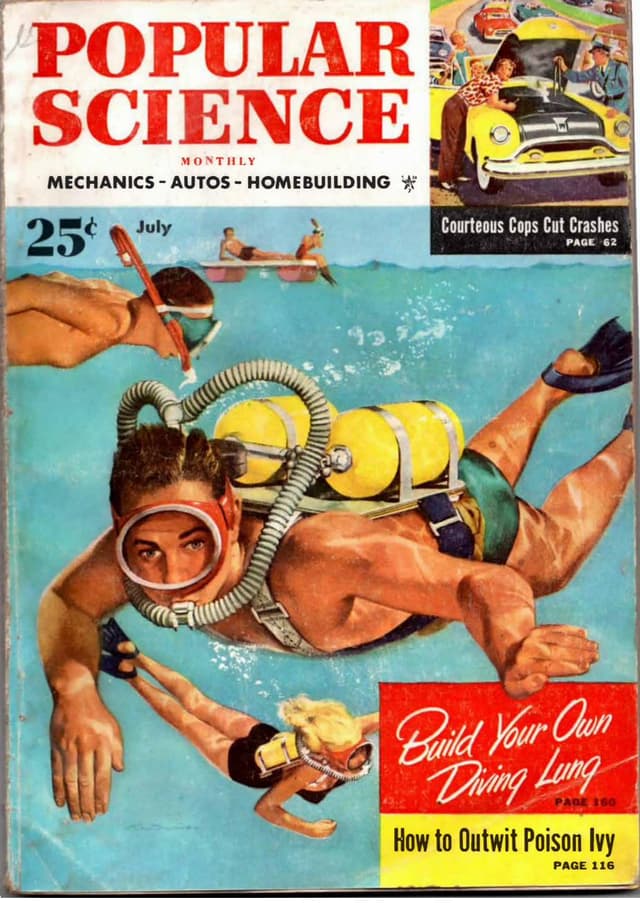
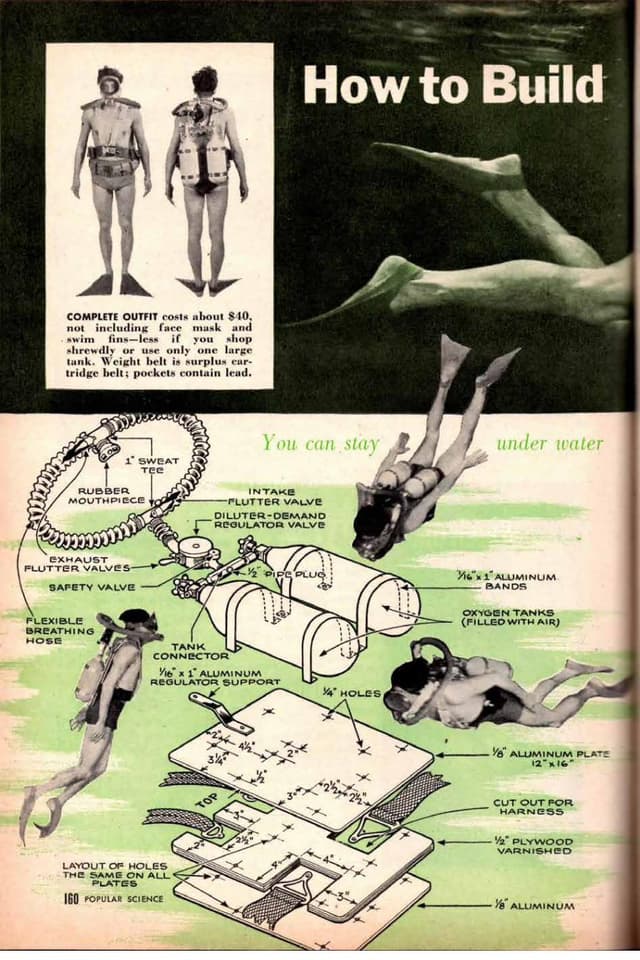
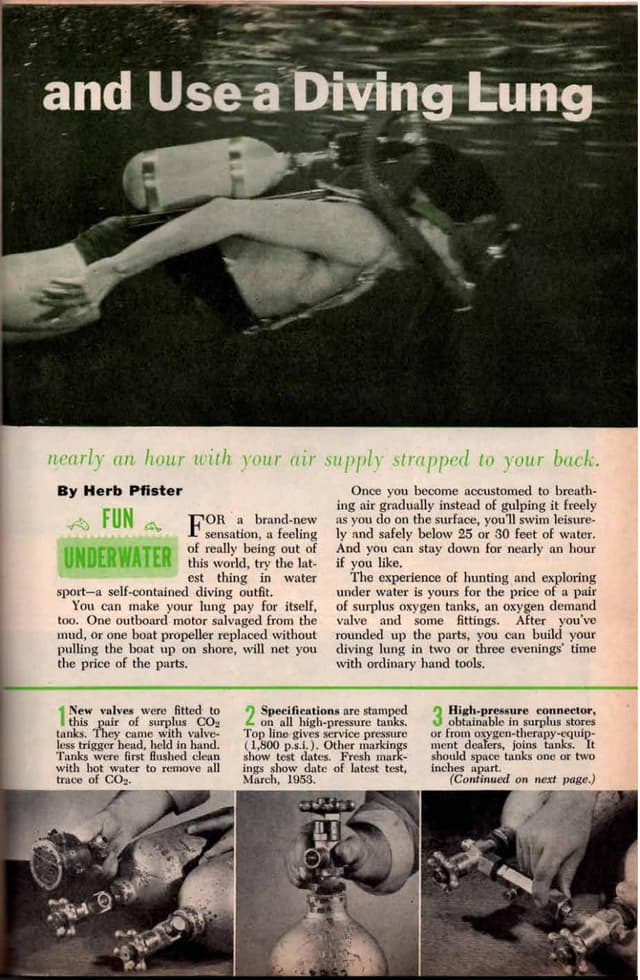
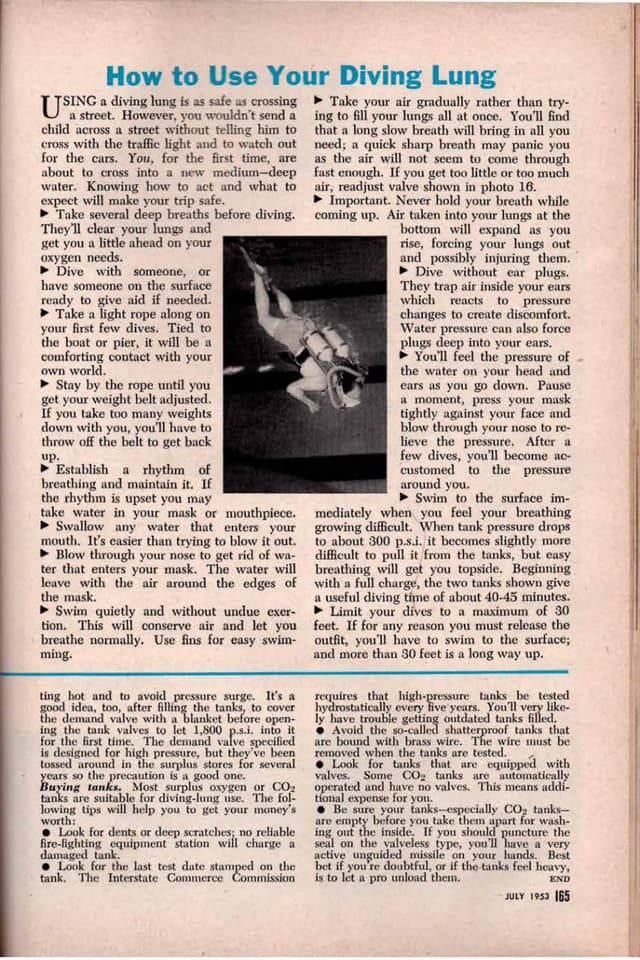
Ask a room full of lawyers today about the idea of publishing “Build Your Own Rebreather” on the internet — complete with diagrams, parts lists, and step-by-step instructions — and you’d see a collective outbreak of cold sweats, loosened collars, and frantic reaching for liability waivers. The mere thought of it would send them diving for cover (pun intended). Yet in 1953, a major national magazine ran exactly that kind of article on its front cover and nobody batted an eyelid.
That article is over seventy years old now, but the philosophy behind it — that knowledge should be shared openly, that ordinary people are capable of extraordinary things, and that the best safety comes from understanding rather than restriction — is the beating heart of this website.
The Maker’s Revolution
In 2012, Chris Anderson published Makers: The New Industrial Revolution, a book that described how the explosion of the internet, affordable 3D printing, and open-source design tools was putting the power of manufacturing back into the hands of individuals. The thesis was compelling: the same digital revolution that transformed media and software was coming for hardware. Anyone with a laptop and a 3D printer could now design, prototype, and produce physical objects that would have required a factory a generation earlier.
The book struck a chord because it described something people could already feel happening. Maker spaces were springing up in cities. Open-source hardware projects like Arduino and RepRap were proving that communities could design and iterate on complex systems without corporate backing. The barriers between “consumer” and “creator” were dissolving.
But the book also pointed to something older — a tradition of self-reliance and practical ingenuity that predated mass manufacturing. A time when people built, fixed, and modified things as a matter of course. Not because they had to, but because they could, and because it was deeply satisfying to understand the things you depended on.
What Happened In Between
Somewhere between the 1953 workshop and the modern maker space, something shifted. A culture that once accepted that accidents sometimes happen gradually gave way to one that insisted someone must always be to blame. The shift wasn’t sudden — it crept in through the 1980s and 1990s, nudged along by a legal profession that discovered there was serious money in liability claims, and an ambulance-chasing culture that turned every mishap into a potential payday.
The result was a well-intentioned but increasingly suffocating safety culture — one that often protects institutions from lawsuits more effectively than it protects individuals from harm. For aspiring inventors and entrepreneurs, the barrier to creating something new and offering it to others grew enormously. Not because the engineering got harder, but because the bureaucracy around it became almost impenetrable. The fear of being sued for everything — including the shirt on your back — has stifled a generation of innovation by private individuals who might otherwise have created something remarkable.
None of this is to say that safety standards are bad. They’re not. CE marking, product testing, and engineering standards exist for very good reasons, and many of them have saved lives. But there’s a difference between informed caution and institutionalised fear. When the default response to “can I build this?” becomes “you’d better not, in case someone sues you,” something valuable is lost.
This site exists, in part, because we think that pendulum has swung too far. We believe that with good information, honest safety guidance, and a willingness to take personal responsibility, individuals can build things that are every bit as safe and well-engineered as commercial products — sometimes more so, because the builder understands every component, every connection, and every design decision intimately.
The Information Is Out There (Barely)
Here’s the good news: the science of rebreather construction has reached something of an epoch. Decades of military research, commercial development, and academic study have produced a deep and well-documented body of knowledge about how to design, build, and safely operate a rebreather. The engineering principles are well understood. The materials are readily available. The tools have never been more accessible.
Here’s the bad news: finding that information is a nightmare.
The knowledge you need is scattered across hundreds of sources — military technical reports buried in institutional archives, manufacturer datasheets that assume you already know the fundamentals, academic papers written for other academics, and the personal websites of early home-builders who were doing this work at the turn of the millennium.
Those early pioneers — people who took surplus military rebreathers like the IDA-71, or modified commercial units like the Draeger Dolphin and Ray, and converted them into manual closed-circuit systems — documented their work on personal websites and early diving forums. They shared their designs, their mistakes, their testing results, and their hard-won insights with a generosity that defined the best of early internet culture.
Sadly, many of those websites have disappeared. Server contracts lapsed. Domain names expired. Hosting providers shut down. The only way to access some of this material now is through the Wayback Machine — and even that is incomplete. A generation of practical rebreather knowledge is slowly vanishing from the internet, one dead link at a time.
The information exists. The science is settled. The engineering is understood. The only thing missing is a single place that brings it all together in a way that ordinary people can actually use. That’s what this site is for.
What We’re Doing About It
Rebreathology.com is an attempt to gather all of that scattered knowledge into one place — and to present it in a way that’s accessible, well-organised, and genuinely useful, whether you’re reading about rebreathers for the first time or designing your tenth scrubber canister.
We’re not inventing new science. We’re curating, organising, and explaining the science that already exists. We’re recovering technical documentation that’s at risk of being lost. We’re building interactive tools that make complex calculations straightforward. We’re creating a CAD library so that builders don’t have to start every component from scratch. And we’re writing it all in language that treats readers as intelligent adults who deserve clear explanations, not jargon-filled gatekeeping.
Everything on this site is free and open source. The content is licensed under CC BY-NC-SA 4.0. The code is licensed under GPLv3. The whole project lives on GitHub. There are no paywalls, no subscriptions, no sponsored content, and no ads. This is a labour of love, built for the community, by the community.
Who’s Behind This?
We prefer to let the work speak for itself.
This project was started by a diver, engineer, and lifelong tinkerer who believes that knowledge should be freely shared and that the best way to stay safe is to truly understand the equipment you depend on. Beyond that, the identity behind the site isn’t particularly important. What matters is the quality of the information, the clarity of the explanations, and whether this resource helps you build something you’re proud of.
Rebreathology.com is an open-source project, and we hope it will grow to include contributions from many people — divers, engineers, builders, and enthusiasts who share the belief that this knowledge belongs to everyone. The site is bigger than any one person, and that’s exactly how it should be.
Why “Rebreathology”?
Because it captures exactly what this site is: the study of rebreathers. The “-ology” suffix felt right because this is, at its core, an educational project. We’re students of the subject as much as we are teachers of it.
But “study” doesn’t just mean the science — the engineering, the physics, the chemistry. It also means the art. The human element. The skill of diving a rebreather safely, reading the loop, understanding what’s happening inside the machine while you’re underwater relying on it. The science gets you a functioning rebreather; the art keeps you alive on it. Both deserve serious attention, and both are covered here.
Are You a Rebreathologist?
You might be a rebreathologist if you find yourself thinking about rebreathers when you’re not diving one. If you’ve ever caught yourself sketching scrubber canister designs on the back of a napkin. If your browser history is 40% orifice flow calculations and 60% obscure military surplus listings. If you’ve ever explained the difference between passive and active addition to someone who made the mistake of asking “so what’s that thing on your back?” at a barbecue — and they slowly backed away while you were still talking.
Rebreather divers are, by nature, gloriously nerdy. They love the diving — the silence, the efficiency, the closeness to marine life — but they love the technology just as much. The engineering is part of the joy. If that sounds like you, welcome home. You’re among friends.
Also, the domain was available. Sometimes it’s that simple.
What This Site Believes
Every project has a set of values that shape it, even if they’re never written down. Here are ours:
Knowledge should be free
The information needed to build a safe, functional rebreather shouldn’t be locked behind paywalls, proprietary manuals, or institutional access. If the science exists, it should be shared.
Understanding is the best safety device
A diver who understands their equipment at a fundamental level is safer than one who simply trusts a label. We’d rather give you the knowledge to make your own informed decisions than tell you what to do.
People are capable of more than they’re given credit for
Building a rebreather is not magic. It’s plumbing, basic engineering, careful thinking, and rigorous testing. If you can follow instructions, use hand tools, and commit to doing things properly, you can do this.
Honesty beats reassurance
We will always be upfront about what’s difficult, what’s dangerous, and what we don’t know. You deserve accurate information, not comfortable half-truths.
The community is the project
This site is open source because the best ideas come from collaboration. Every contribution — a corrected typo, a new CAD file, a better explanation — makes the whole project stronger. We’re building this together.
The 1953 Popular Science article that inspired this project opened its safety section with the line: “Using a diving lung is as safe as crossing a street.” Seventy years on, we might phrase that differently — but the confidence in the reader’s ability to learn, understand, and take responsibility? That hasn’t changed one bit.
Thank you for being here. Now go and build something remarkable.